Abstract
How do students use ‘virtual boots’ in these expeditions?
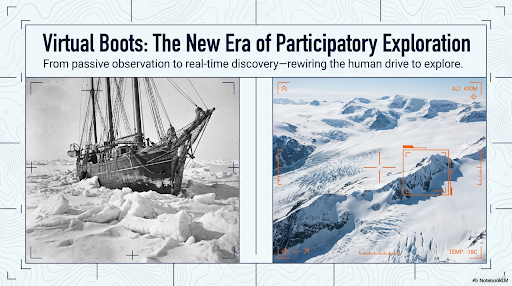
Putting on “virtual boots” allows students to transition from passive observers to active, real-time participants in remote scientific expeditions. By connecting through advanced telepresence networks from their classrooms, students step directly into the ongoing journey of discovery rather than simply reading about past events in textbooks.
Students use their virtual boots to engage directly with the expedition in several hands-on ways:
Observing real-time conditions: They utilize live video streams, wearable cameras worn by researchers, drone footage, and optional virtual reality environments to experience the exact terrain, weather, and scientific challenges the field team faces.
Analyzing authentic field data: Instead of just watching broadcasts, students engage in structured activities like examining incoming environmental sensor data, analyzing digital maps, and actively assisting the team by identifying biological or geological samples.
Collaborating with the field team: Participants attend daily expedition briefings, listen to researchers, and can even propose new research questions for the physical team to investigate on-site.
Ultimately, using virtual boots integrates students into a distributed scientific community, allowing them to experience the genuine uncertainty, unpredictable discoveries, and real-time decision-making that define true exploration.