Back Story
What started out as a messaging protocol that mathematically transformed Natural Language into vectors in a bounded space evolved into something more, something interdisciplinary that transcended encryption, encoding, and messaging.
First it important to Recall the meaning of High Entropy Encoding systems
Human languages are often treated as low-entropy systems: ordered, predictable, and compressible. But this order is the product of consensus not a native property of language. In their most primitive forms, languages are high-entropy systems—disconnected symbols, ambiguous meanings, with no fixed structure. Only through shared interpretation and repeated use does their entropy decrease, making them accessible to others. Classical information theory, while useful, fails to capture this dynamic; it models language as symbol streams with statistical regularity, ignoring the relational scaffolding that gives language its meaning.
The Unanticipated Paradigm Shift.
Imagine two teams — one on Earth, one on a spacecraft orbiting Saturn.
Each team has a set of alphabet blocks, arranged identically from A to Z.
Now, instead of sending a message like “HELLO,” one team sends only a list of numbers. The receiver rearranges their blocks using those numbers, and suddenly their board reads:
“MEET AT SITE 9”
No message was sent.
No encryption, no cipher — just a set of instructions to reconstruct a message from the shared structure.
Welcome to vector-based messaging — a radical new paradigm where:
The signal doesn’t carry the message.
The signal carries the instructions to reconstruct it.
Messaging Through Position, Not Payload
In traditional communication systems, everything rides on the signal:
- Morse code sends pulses.
- FM/AM modulate frequency or amplitude.
- TLS encrypts payloads and sends encrypted packets.
In all these, the message is embedded in the transmission.
But vector-based messaging — like that implemented in the Sub-Lex protocol — flips this assumption completely:
- The message is never sent.
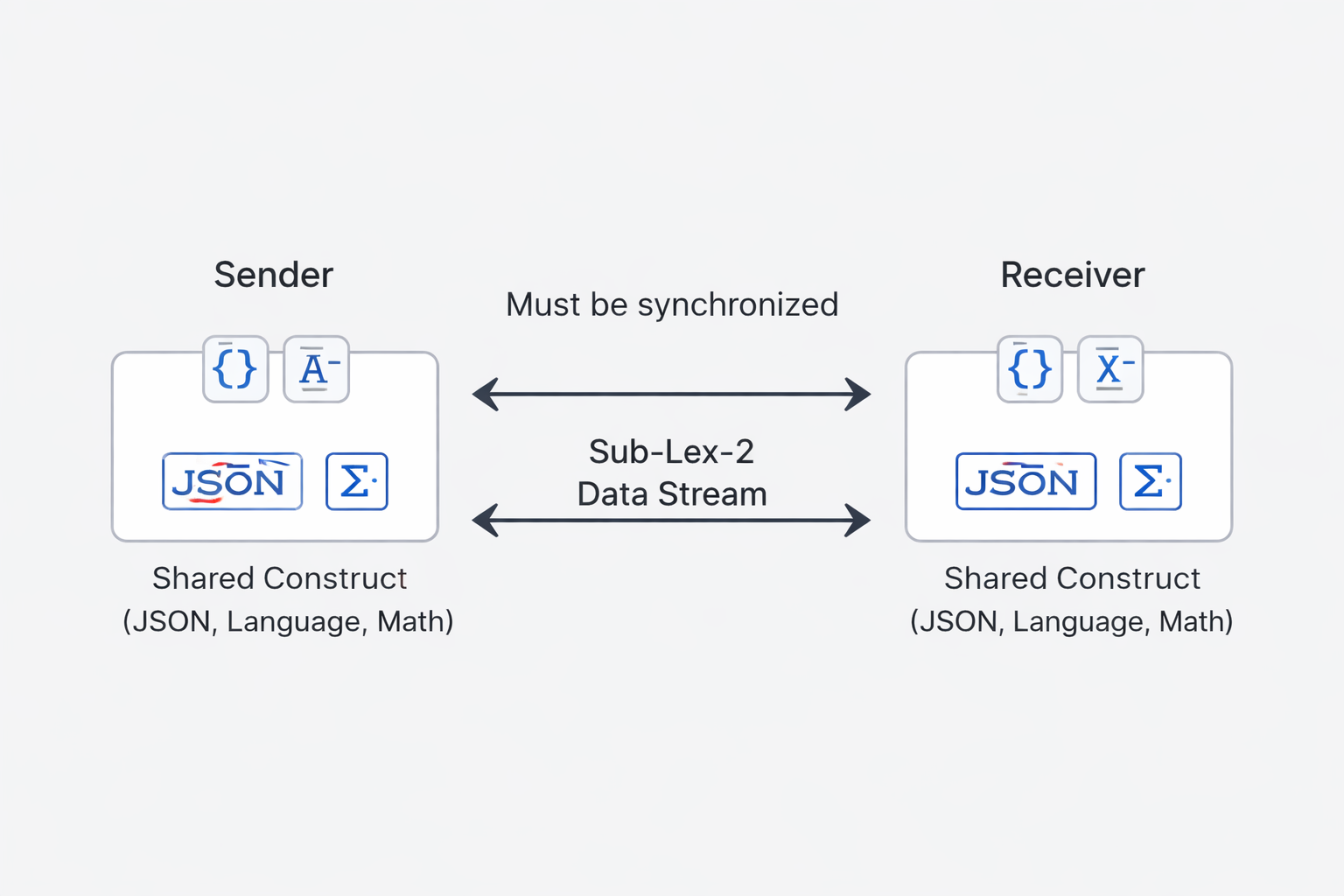
- Instead, a set of positional vectors is transmitted, referencing a shared symbolic state.
- Only someone holding the exact same state can reconstruct the message.
This requires an initial synchronization phase — a shared symbolic construct that both sides must already possess before any exchange can occur.
If they don’t? They receive nothing but noise.
HEES Generalization
Sub-Lex is just one instantiation of a broader principle we call High Entropy Encoding Systems (HEES).
Any shared charset can participate in this model — natural language, JSON schemas, mathematical symbols, or even abstract operator sets.
The carrier doesn’t matter. What matters is the synchronized internal mapping.
HEES treats meaning as something reconstructed locally from shared structure, not transported through the signal itself.
For AI systems, this model is especially natural. Once two agents share the same construct, communication becomes state evolution rather than message passing — a sequence of coordinated transformations instead of symbolic exchange. Human-readable formats become a view layer, not the protocol itself.
That connects directly to:
-
Sub-Lex-2
-
math charset
-
JSON
-
non-symbolic paths
The Chameleon Effect
A Note on Entropy
When we talk about entropy here, we are not referring to Shannon entropy or information-theoretic compression.
We mean physical entropy: disorder relative to an observer’s model.
The transmission appears entropic not because it is maximally random, but because meaning cannot be resolved without the correct shared state.
The first time you encounter a Sub-Lex-2 message—a string of high-entropy numbers it walks and talks like a language. You think this is encryption. But it isn’t. There’s no shared key in the cryptographic sense.
There’s no data in the payload. It’s not encrypted — it’s empty, until meaning is synthesized locally through shared understanding.
This is what we call chameleon encoding:
It mimics encryption, but operates in a completely different conceptual space — relying on positional logic and stateful alignment, not obfuscation.
Like Chess at the Edge of the Solar System

Imagine trying to play chess across interplanetary space.
You don’t send the whole board. You don’t stream every move. You just say:
“Queen to KB3.”
But that only means something if:
- Your opponent has the same board,
- The same history of moves,
- And the same understanding of the rules.
Change the board — or misalign the state — and the move is meaningless.
This is how HEES specifically Sub-lex-2 works.
It doesn’t transmit messages — it transmits movement.
Virtual Entanglement
In quantum mechanics:
- Entangled particles share a state.
- Measuring one instantly defines the state of the other — regardless of distance.
- If the state is disturbed, coherence is lost.
In Sub-Lex:
- Sender and receiver share an initial symbolic state (e.g. a narrative or structure).
- A Sub-Lex message is a set of vector instructions that only resolve meaning if the receiver holds the exact same interpretive frame.
- Disturb that frame (shift the structure, apply the wrong transform), and the message collapses into irrelevance or noise.
The parallel is uncanny:

The Alien Signal Problem
SETI implicitly assumes that an advanced civilization would deliberately transmit symbolic messages outward — mathematical beacons, prime sequences, or obvious structured signals. But if such civilizations resemble ours, they likely won’t broadcast at all. Their communications would be internal, contextual, and embedded in ongoing activity. Any signal we intercept would not be a greeting — it would look like meaningless noise unless we happened to share the interpretive framework.
SETI and other projects have spent decades listening for:
- Narrow-band beacons
- Pulses
- Regular intervals or modulations
- But what if the signal:
- Isn’t in the signal at all, but in the pattern of entropy?
- Looks like random noise unless you know the interpretive framework?
That’s exactly what Sub-Lex models:
A system where meaning is entangled with symbolic state, and the transmission itself is high-entropy, context-dependent noise.
Why This Matters for Interstellar Messaging
In Earth-like systems:
- We assume shared biology, linguistics, or math.
In HEES or alien HESS analogs:
- You send structure.
- You embed vectors into a medium that appears meaningless.
- Meaning only emerges if the receiver:
- Has the same symbolic foundation
- Understands the entropic framework
- Applies the right vector mapping
Key Concept:
A truly advanced civilization may not send a message at all —
it may seed structure, and let interpretation emerge through entangled context.
Imagine receiving a vast array of high-entropy data, like:
- A snapshot of a quantum field
- Cosmic microwave data rearranged by drift logic
- A “text” that is just 1,000,000 letters long — but whose structure encodes a path
To everyone else: noise.
To someone in the right frame: contact.
Not your Grandmother’s Contact
“An alien message may not be in the signal, but in the subtle displacement of the meaningless.”
Or even: If we ever hear from the stars, it may not sound like a message — it may sound like static. But the pattern will move with intent.”
Wrap-Up
This isn’t your grandmother’s idea of “contact.”
Sub-Lex doesn’t send messages. It sends movement through shared symbolic space.
It’s not encryption. It’s not compression. It’s not even transmission in the traditional sense.
It’s a new class of protocol — one where meaning is entangled with context, not carried by signal.
Whether used for secure human messaging or listening for intelligence across the stars, the premise is the same:
Sub-Lex and its vector-based encoding system hint at a truth we’ve overlooked:
The message may never be in the signal at all.
The message may be in the structure of space, waiting to be resolved by alignment — not reception.
This is not just a communication model.
It’s a new way of thinking about meaning, intention, and synchronization — from protest coordination here on Earth to silent contact across the stars.
In depth related References :
Original Version of this article