Abstract
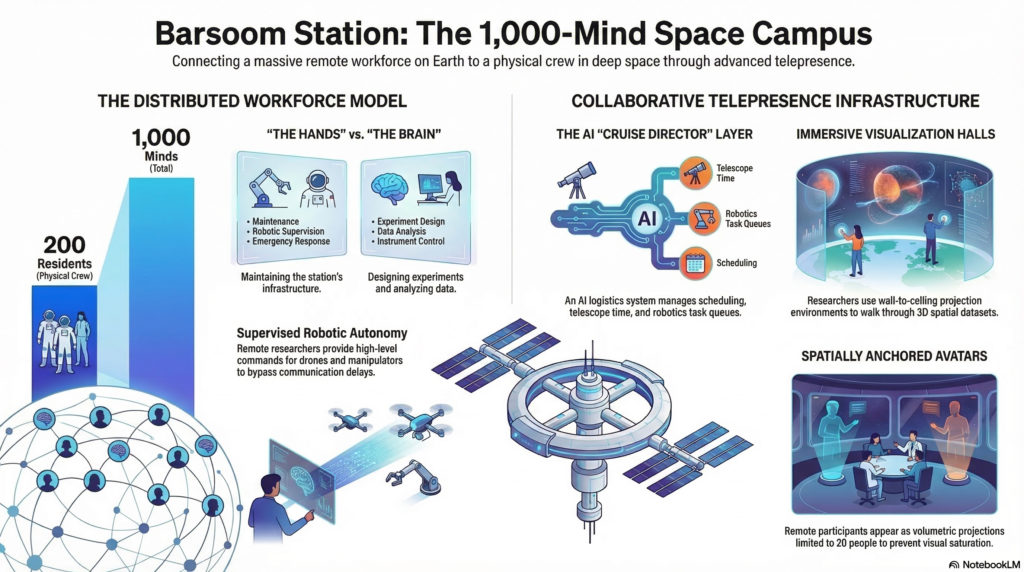
The Barsoom Station operates as a sophisticated distributed research campus that bridges the gap between deep space and Earth through advanced telepresence technology. While the physical facility houses a small crew of on-site technicians, the majority of its intellectual output is driven by a remote workforce that controls instruments and conducts experiments from home. An integrated AI coordination layer manages the complex logistics of this arrangement, overseeing everything from robotic task queues to satellite bandwidth. Collaboration occurs primarily within immersive visualization halls, where Earth-based scientists appear as volumetric avatars to interact with data alongside the physical crew. This architectural model significantly reduces the costs of space exploration by allowing hundreds of researchers to inhabit the station’s systems without ever leaving Earth. Ultimately, the station functions as a physical interface for a global scientific community, effectively expanding its labor force far beyond its life-support capacity.
Designer Notes
Rather than relying on basic video calls, Earth-based researchers use a sophisticated suite of technology to actively inhabit and manipulate the remote environment. They can schedule experiments, control free-flying drones, and operate massive orbital telescopes with the help of an AI Assistant that functions as a Cruise Director.
The most critical feature of this telepresence model is how it enables deeply integrated collaboration through immersive visualization halls. These rooms act as next-generation CAVE (Cave Automatic Virtual Environment) systems, featuring micro-thin wall panels, ceiling displays, and floor screens that allow the physical crew to literally walk through gigantic, three-dimensional datasets, such as simulations of the Oort Cloud.
Earth-based researchers join these spaces as volumetric projections, depth-mapped holograms, or light-field silhouettes, standing shoulder-to-shoulder with the physical crew millions of miles away. To make this collaboration highly functional and grounded in realistic systems design, the telepresence environment utilizes several constraints:
Preventing Avatar Saturation: To avoid visual noise and cognitive overload, only about 20 virtual participants can project into the visualization hall at one time, functioning much like a focused seminar room.
Spatial Anchoring: Instead of holograms floating randomly and obstructing data, remote researchers are projected onto transparent, micro-thin sheets distributed around the room. These act like “phone booths,” giving every remote worker a specific, predictable physical anchor point.
By confining the avatars to these specific projection layers, the primary scientific data remains the dominant visual focus of the room. Ultimately, this allows telepresence to create a true distributed campus, successfully blurring the line between being on Earth and being in deep space
How does the AI Cruise Director coordinate the virtual researchers?