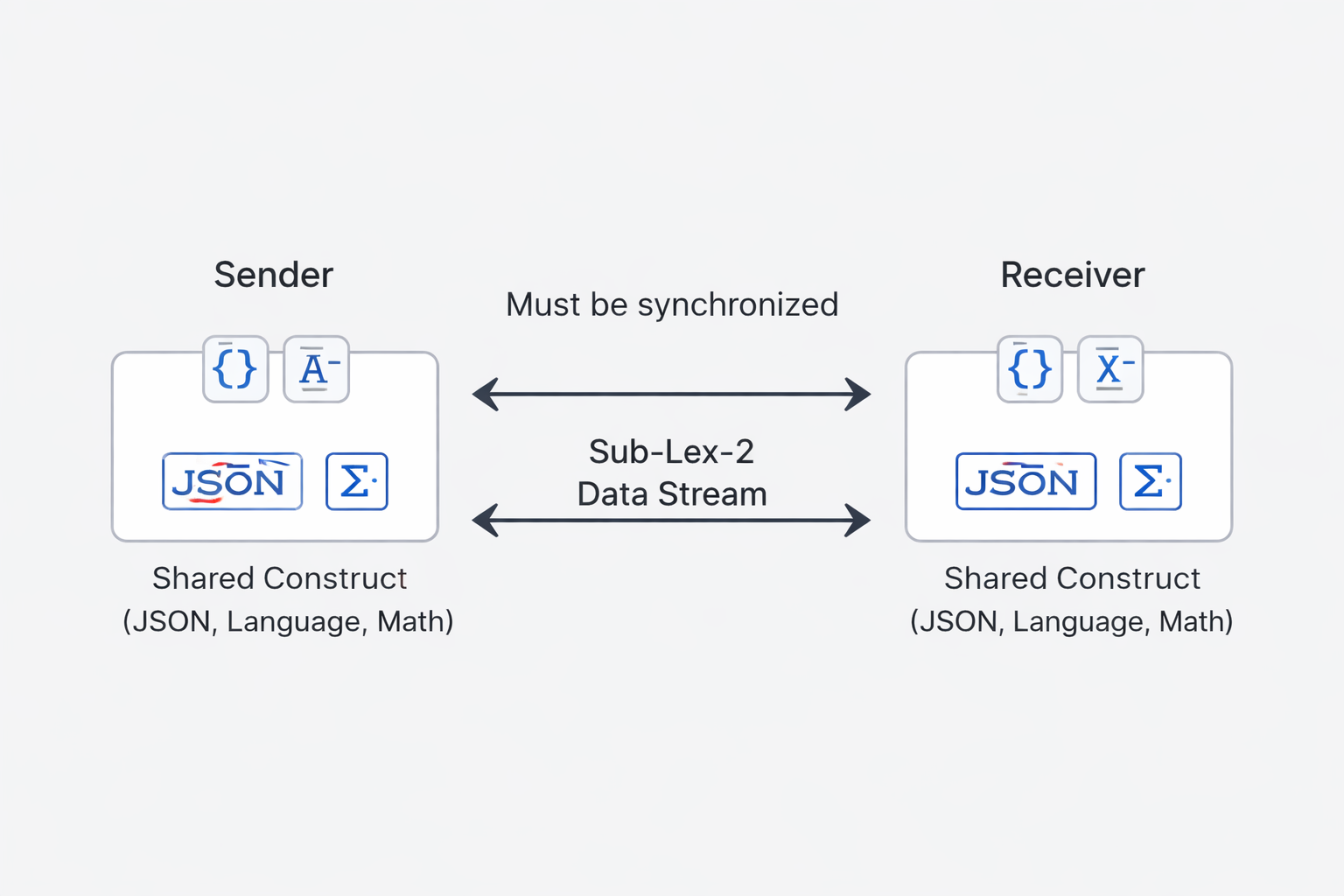
Can we create a classical analog to Quantum entanglement?
Setup for the Thought Experiment
Let’s play a game.
Here’s the setup.
You play a commodities broker. You make bids on commodities like corn, soybeans, beef. Bids are in the form:
100 dollars is my bid for soybeans.
That’s the format.
Bids are always between 100–999.
I’m an analyst. I sit next to you and report on your bids.
In addition to our screens, we also have a small set of numbered blocks, 0–9.
In the bid message we monitor mapped fields 1–3.
The bid values are vectors to the blocks.
A bid of 100 is block 1, followed by two blocks 0.
I have to know the state of the whole system to record your bid, which is easy. (Sound Familiar)
I just need to look over your shoulder.
You send the message 200 for soybeans , which changes it from 100 to 200, I observe you and I change my blocks accordingly let’s say I’m very fast and that’s instanenous

The Message Carrier Is Irrelevant, Dependent Only on the Situation
You decide I’m annoying.
I don’t comb my hair in the morning. I wear my pajamas.
So you erect a barrier.
Now the situation is like a game of Battleship.
Now you must call out your bid change.
Location Is Only Relevant for the Carrier, Not the Message or the Construct
I complain.
I don’t like your attitude. You’re fond of vaping, and that bothers my sinuses.
My agency moves me across town to another office.
You can phone me.
Or text me.
the carrier changes now but not the state or the outcome , the experiment and expected result remain the same regardless of distance .
Conclusions
Now let’s take this hypothetical situation and extend it by adding time lag with each step:
Across town.
The Moon.
Mars.
Saturn.
One light year.
Many light years.
Each time, we ask the same question:
Did the commodity change still happen instantaneously?
From the system’s point of view, yes.
Not because information traveled faster than light —
but because the state change was already defined by a shared mapping.
The carrier changes.
Distance changes.
Latency increases.
But the construct does not.
Entanglement at the quantum level is affected by quantum principles — Heisenberg uncertainty, observing the system changes the system.
In practice, you need an external reference — something outside the system — to resolve the true change in position once observation has altered the state.
Can we simulate this in our classical message system?
The answer is yes.
Our Sub-Lex-2 messaging introduces an entropy-destroying drift calculation across the message and a shuffling of the construct on both the receiver and sender side, derived from a seeded key.
In essence, this key is that external reference — it works out the true vector from the drifted position.
So, leaving out quantum effects, we can clearly state that you can create analogs to quantum messaging.
Which brings us to:
Quantum vs what I’m calling Classical Entanglement
Score Card
Messaging Achieved:
Quantum
Classical (ie Sub-Lex-2)
Both systems successfully transmit meaning based on shared structure.
Instantaneous Construct Resolution (after carrier arrival):
Quantum
Classical
In both cases, once the carrier arrives, the state resolves deterministically because the mapping already exists.
Distance Independence:
Quantum
Classical
Across town, Moon, Mars, Saturn, or light years — distance affects latency, not outcome.
Tamper Detection:
Advantage: Quantum
We cannot completely simulate the observer changing particle position and momentum.
Quantum systems get intrinsic disturbance from measurement.
Classical systems must engineer this via drift, shuffle, and external reference (the seeded key). We can detect tampering, but we can’t reproduce true Heisenberg-style uncertainty.