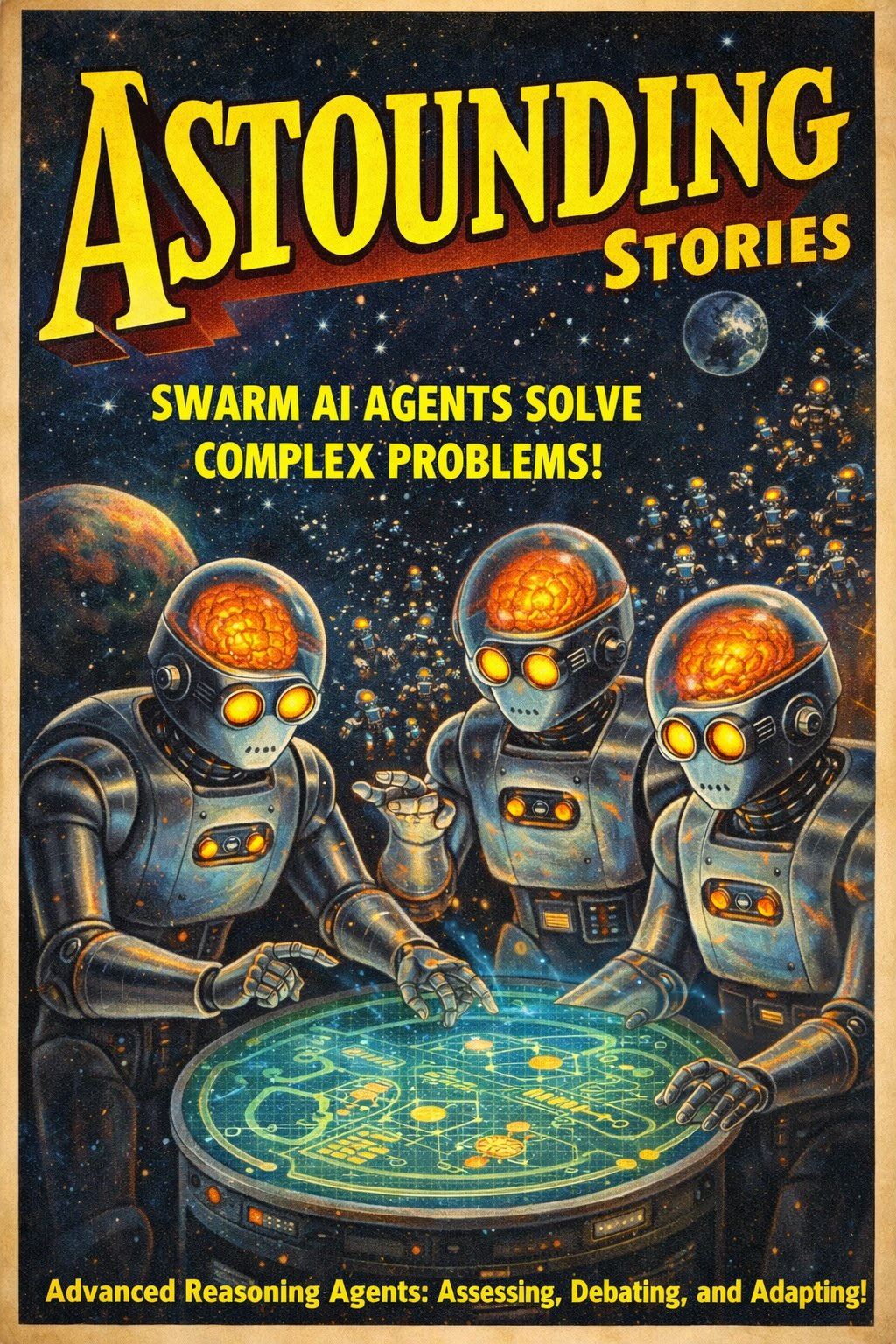
The Nobel was dead.
Shocking news — but not as shocking as the image he held in his hand: a still frame, grainy and damning. It showed the Protectorate — chief advisor to the royal — mid-altercation, the crack of a neutron pistol frozen in time.
Enter the investigator. She didn’t look like a detective. More like a seer, or one of those wandering subjects paid to uncover lies.
She studied the photo briefly, then opened a small metal box. Out poured what looked like golden ants.
The swarm moved with purpose — each tiny node an electronic brain, trained to examine a sliver of the image. They circled, clustered, paused. And then: stillness.
She drew a sheet from her cloak. Not parchment — polymer. A result. She handed it to the royal.
“It’s a fake,” she said.
Not just a good fake — a masterwork of deception. But forgery nonetheless.
Who would frame the Protectorate? And why?
These were the agents we grew up reading about — the dreaming swarm-minds of Foundation and I, Robot. Not prophecy, but intuition: stories drawn from bee hives and ant trails, long before the tech existed.
Then Bridge to Present Day
Today, those swarms are real.
Multi-agent convolutional networks — trained not as monoliths, but as synchronized minds — are reshaping how we detect deepfakes, interpret images, and even reconstruct memory.
Read the Substack Post that describe a concept for Image analysis.