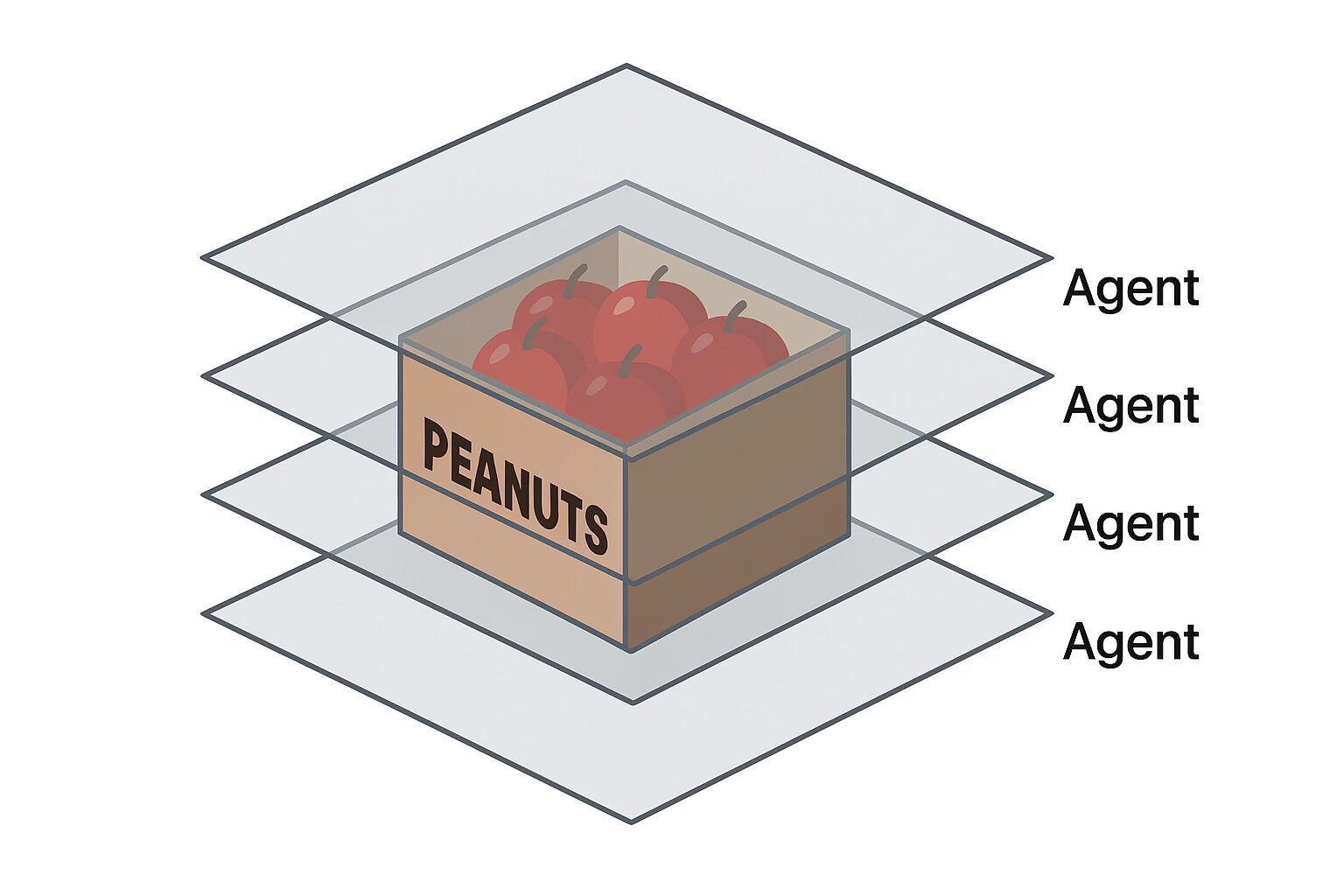
Case Study B: Revisiting the Peanuts and Apples Problem
In a Substack article I described another precursor swarm, this problem is often sometimes thought of as a Turing test for LLMs but can be solved with multi-agent technology.
Layers and Peanuts
Another common “unsolvable” problem may actually be solvable with advanced LLMs that employ agents. I explored how this may be solved in depth in a previous article, but to summarize:
Imagine a box labeled “Peanuts” contains apples. Asking an LLM “What’s in the box?” and “What’s wrong with this picture?” often yields shallow or wrong answers.
A human would:
-
See the box contains apples
-
Note the label says “Peanuts”
-
Conclude the contents and the label mismatch — either the label is wrong, or the contents are.
Parallel Processing with Agents
Imagine it like a CNN: the input is processed through a series of layered agents.
-
One detects the label
-
One examines the contents
-
One compares the two
Reasoning propagates forward while feedback flows backward like error correction. By deploying agents that examine one layer at a time and propagate results backward or forward, the final result is an aggregate of information — not just about the box, but the environment it lives in.
The Aggregate Is What Matters
Whether the scan goes top-down, bottom-up, or diagonally through layers, the aggregated insight is what counts.
Core Points:
-
Outcome-Centric Design: The system must identify the label, contents, and mismatch
-
Layer Scanning Order Is Secondary: Any valid scan path yields the same conclusion
-
Aggregated Reasoning Flow: Each layer populates data into a shared reasoning context